Mostrando entradas con la etiqueta silver. Mostrar todas las entradas

jueves, 1 de junio de 2023

Aprenda a recuperar plata metalica de materiales fotográficos como radiografías y otros por métodos quimicos

Aprenda a recuperar plata metálica de materiales fotográficos como radiografías y otros por métodos químicos

E-BOOK RECUPERACIÓN DE PLATA 
METÁLICA DE MATERIAL RADIOGRÁFICO

Libro electronico o Ebook de Recuperacion de plata de material Radiografico de Herwarth Morales

OBJETIVOS 

- Aprender los conceptos teóricos básicos de la materia prima, insumos y materiales de laboratorio    que se aplicaran en este método de recuperación. 
- Aprender el método para recuperar plata de material radiográfico y otros
- Conocer los equipos y materiales a utilizar
- Aprenderá los procesos de Lixiviación, Decantación, Filtración, Secado y Fundición básica para recuperar plata metalica. 

DIAGRAMA DE BLOQUES DEL PROCESO DE RECUPERACIÓN DE PLATA DE MATERIAL RADIOGRÁFICO


 PRINCIPALES PROCESOS QUÍMICOS:
1. Lixiviación
2. Decantación
3. Filtración
4. Secado
5. Fundición


Ahora también puede aprender en su eBook o libro electrónico de su preferencia:
1.- Reciclaje de ordenadores o computadores (microprocesadores, placas electrónicas, placas telefónicas).
2. Recuperación de platino, paladio y rodio de Catalizadores Catalíticos
3. Aceite esencial de Molle o Pirul.
4.Control de calidad en una planta embotelladora
5.Tratamiento de relaves auríferos entre otros.

INFORMES:

herwarth5@yahoo.es


Ebook de Reciclaje de Metales Preciosos

Nuevo libro electronico o eBook de Recuperación de Platino, Paladio, Rodio de Catalizadores Catalíticos, disponible ahora en TIENDAS KINDLE DE AMAZON.

Cualquier pregunta o duda escribir al email: herwarth3@gmail.com


VERSION 2019
AUTOR: ING. CIP HERWARTH MORALES

Visite directamente con este link:


Product details
File Size: 27604 KB
Print Length: 123 pages
Simultaneous Device Usage: Unlimited
Publication Date: January 28, 2019
Sold by: Amazon Digital Services LLC
Language: Spanish
ASIN: B07N7K73XT
Word Wise: Not Enabled
Lending: Not Enabled
Screen Reader: Supported 
Enhanced Typesetting: Enabled 


Usted ha ingresado al mundo de la metalurgia extractiva que abarca conceptos tan antiguos como la pirometalurgia (fuego), hidrometalurgia (agua) y 

electroquímica (energía) que en muchos sentidos, es el equivalente moderno de la alquimia al cual pertenecieron distinguidos científicos, como Isaac 

Newton y Robert Boyle. 
En este manuscrito se dan a conocer los métodos más utilizados para recuperar el platino y los metales del grupo de los platinos (PGMs) a partir de 

catalizadores o convertidores catalíticos usados o desechados aplicando el método hidrometalúrgico, extracción con disolventes o lixiviación acida.
Se pretende proporcional un método didáctico y práctico de ser posible la ejecución del resultado mucho más pragmático y funcional.
El propósito del manuscrito es dirigirse a toda persona interesada en el reciclaje de PGMs a partir de los convertidores catalíticos, pudiendo ser también 

de utilidad a aquellos que se dedican al conocimiento o la investigación.
El presente libro consta de 4 capítulos distribuidos así:
En el Capítulo I se realiza el estudio general de los principios básicos sobre los catalizadores que serán la materia prima de la recuperaremos metales 

preciosos como el platino, paladio y rodio presentes en los monolitos cerámicos.
En el Capítulo II se da una guía básica suficientemente clara y concisa sobre cómo realizar el proceso de apertura del Catalizador o Convertidor Catalítico, 

extracción, dado que se encuentra de una estructura metálica de acero que fue diseñada para resistir las condiciones extremas a las que es sometida 

durante su funcionamiento.
En el Capítulo III, trata específicamente del método que se emplea en la recuperación del platino y PGMs presentes en material pretratado como se indica 

en el Capítulo II, en parte se detalla de manera explícita los procedimientos teóricos y prácticos para aplicar el método de extracción con disolventes o SX. 

Usted podrá conocer las reacciones químicas que ocurren durante el proceso recuperación.
En el Capítulo IV, es una especie de apéndice que da a conocer algunos principios teóricos que pueden resultar útiles para principiantes o emprendedores.


Recuperación de Oro de Residuos Electrónicos

Ebook Reciclaje de Oro de Microprocesadores electronicos de Herwarth Morales
Ebook o libros electrónicos en Venta

EBooks o libros electrónicos :
1.- Reciclaje de ordenadores o computadores 

(microprocesadores, placas electrónicas, placas telefónicas).
2. Recuperación de platino, paladio y rodio  de Catalizadores 

Catalíticos 
3. Aceite esencial de Molle o Pirul.
Otros ebooks:
Control de calidad en una planta embotelladora
Tratamiento de relaves auriferos entre otros.


Ahora también puede aprender en su eBook o libro electrónico de su preferencia:
1.- Reciclaje de ordenadores o computadores (microprocesadores, placas electrónicas, placas telefónicas).
2. Recuperación de platino, paladio y rodio de Catalizadores Catalíticos
3. Aceite esencial de Molle o Pirul.
4.Control de calidad en una planta embotelladora
5.Tratamiento de relaves auriferos entre otros.


INFORMES:

herwarth5@yahoo.es


jueves, 20 de abril de 2017

Huge Decline In Peru's Silver Production Suggests Future Supply At Risk


The Peru Ministry of Energy and Mining just released their silver production data for February, and it was a whopper to the downside. Actually, I was quite surprised to see how much the country's silver production declined versus the same month last year. Also, Peru's gold production in February took a similar big hit.

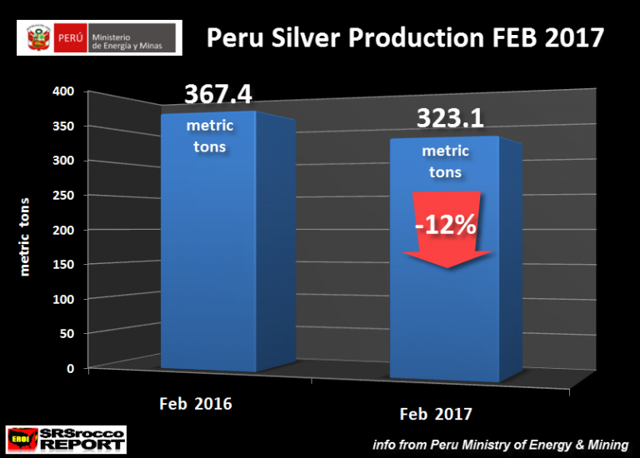
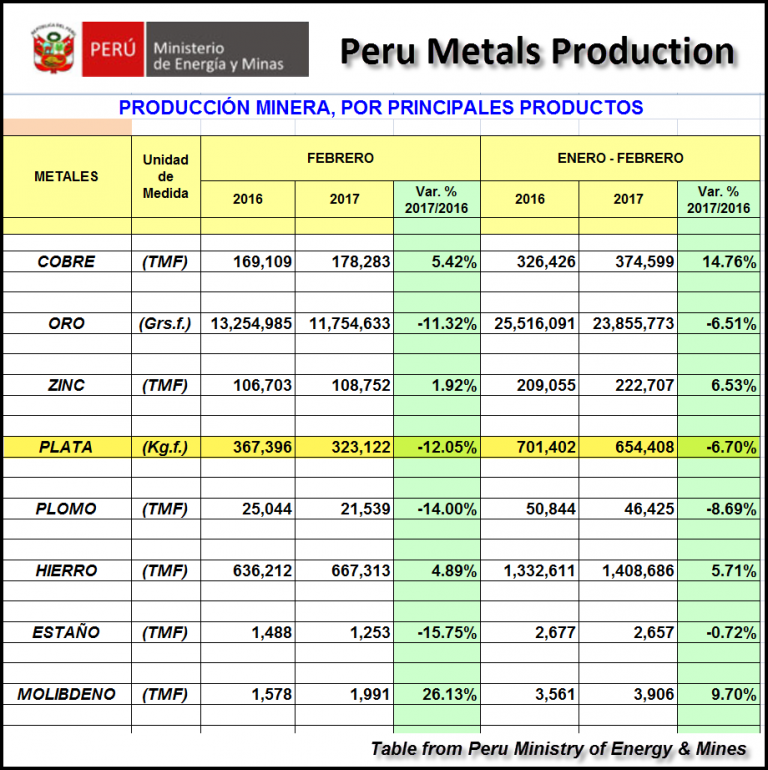
According to the ministry data, the country's silver production fell 12% to 323.1 metric tons (mt) this February versus 367.4 mt the same month last year:

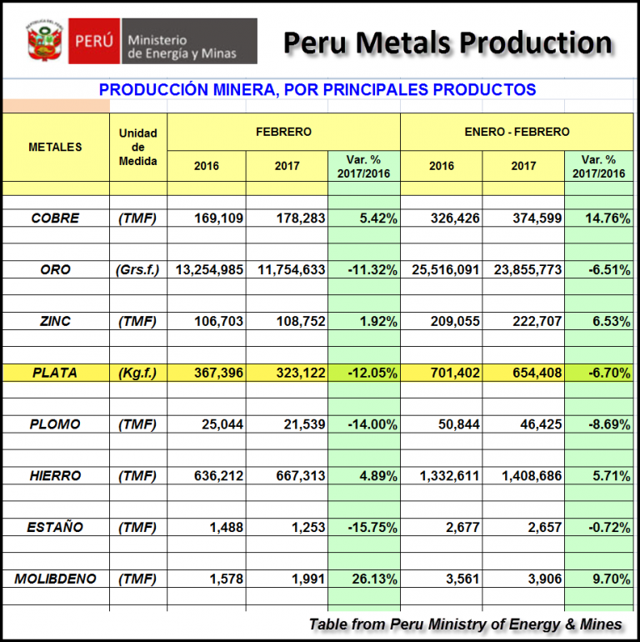
This is a 44 mt decline in one month, nearly 1.5 million oz lost. Here is the table from the Peru Ministry of Energy and Mining showing various metals production data for February:

Silver is shown as "PLATA," and as we see, overall silver production for January-February has declined 6.7% compared to the same period last year. Which means, Peru's silver production took a much larger hit in February than in January.Furthermore, the country's gold production (shown as "ORO") also declined significantly by falling 11.3% in February.

The Peru Ministry of Energy and Mining put out this brief explanation why their silver and gold production declined in February:

However, in this month precious metals slightly suffered a lower production volume gold decreased by -11.91%, while silver -11.29%. In the accumulated January, national production of these precious metals decreased by 6.81% for gold and 6.3% for silver.

In the national production of silver, the Lima region (127,157 kg fine), Ancash (126,816 kg fine) and Junín (116,473 kg fine) regions are in the top positions, associated with the polymetallic exploitation of the center of the country. Peru is the second largest silver producer in the world and boasts the largest proven and probable reserves of this precious metal in the world.

Antamina (101,824 kg Fine) in the Ancash region, followed by Uchucchacua (84,745 Kg. Finos) in Lima and Inmaculada (30,468 Kg Finos) in Ayacucho, among several others.

In the case of gold, the national production accumulated to February 2017, reached 23.8 tons fine. Its production was concentrated in the regions of La Libertad (6.4 tons) contributing the total production in 26.92%; Cajamarca cooperating with 23.32% (5.5 tons fine) and Arequipa (3.03 tons fine) contributing 12.74%. These regions accumulate 63% of the national gold production.

The decrease is explained by the lower results (-23.53%) of the main producer: Minera Yanacocha S.R.L. Whose operations in Cajamarca have been affected by an exhaustion of the reserves in the current deposits in operation.


I don't know why the ministry's data for gold and silver production declines are different in their explanation than what they show in the Excel spreadsheets. However, it is only off by a small percentage. Regardless, the important part of the text above is highlighted in red. The reason for the big decline of Peru's gold production was due to "an exhaustion of reserves in the current deposits of operation." This is a key factor that will be played out across the world as other mines lose production due to the same situation of reserve exhaustion.

We must remember, Peru is the second largest silver producer in the world, right behind Mexico. According to the Silver Institute's 2016 Interim Report, Mexico's silver production is estimated to decline to 183 Moz in 2016 (189 Moz in 2015), while Peru's silver production increased to 141 Moz (136 Moz in 2015).

Global Future Silver Production At Risk

As the global markets finally succumb to the massive amount of debt, economic activity is going to plummet. This will have a negative impact on most energy, metals and commodity prices. Thus, production of base metals will decline significantly. This will impact the production of silver the most, as the majority comes as a by-product of zinc, lead and copper production.

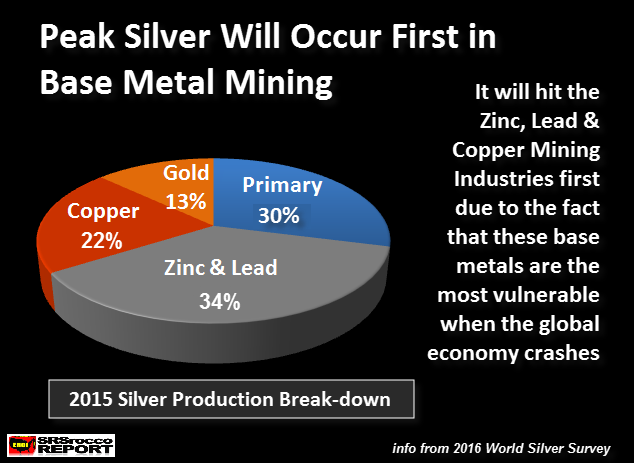
According to the World Silver Survey, 34% of silver production came as a by-product of zinc and lead mine supply, while 22% came as a by-product of copper production. Thus, 56% of global silver production is a result of copper, zinc and lead production:

Which means more than half of the world's future silver production is at risk when base metals prices take a big hit during the next economic crash. People need to realize that using a massive amount of leveraged debt to continue economic activity is not only unwise, it is seriously insane.

While there is no guarantee what the value of gold and silver will be in the future, logic suggests investors holding onto moststocks, bonds and real estate will suffer the financial enema of their life. Again, this is all due to the disintegrating U.S. and global oil industry in the future.

So, place ya bets and let's see who made the better investment decision when the global market finally cracks.

lunes, 16 de enero de 2017

The silver market performed reasonably well in 2016, with the price of the precious metal picking up more than $2 to close the year at $15.88 per ounce


The silver market performed reasonably well in 2016, with the price of the precious metal picking up more than $2 to close the year at $15.88 per ounce. That in turn helped boost the prospects for silver-tracking investments like the iShares Silver Trust (NYSEMKT:SLV). But as much as investors appreciated the gains, they were a far cry from the highs above $20 per ounce that silver posted earlier in the year. Looking forward to the coming year, investors want to see the price of silver in 2017 climb back toward the $20 mark, but those who follow the silver market aren't sure just how much progress the metal can make. Below, we'll look at what could move the price of silver in 2017.


Image source: Getty Images.

What will move silver prices in 2017?

The main difficulty that many people have in assessing the silver market is that it acts like a hybrid, showing characteristics of both precious and industrial metals. On one hand, even at prices that are less than 2% of the price of gold, silver is still roughly 100 times as costly as copper, putting silver in a gray area in the middle of the price spectrum. Historically, traders have seen silver as a precious metal, and many mines produce both gold and silver, further associating them in the minds of investors.

Yet in large part, silver is much more subject to supply and demand considerations than gold. Silver gets used in a wide variety of industrial applications, and that subjects it to the normal demand fluctuations of the global economic business cycle. In addition, mined supply of new silver plays a role in setting its price, along with the willingness of those who have stockpiled silver for investment or personal use to bring it back into the market when prices rise.

Even with those countervailing factors, silver traded largely in line with its precious metal counterparts during 2016. After a big gain linked to an early year stock market decline in 2016 and prospects for a potential collapse in the energy markets, silver climbed to its highest levels by mid-year. However, the final boost from the U.K. Brexit vote to leave the European Union didn't lead to the economic chaos that some had predicted. By the second half of the year, excitement about silver waned, and fears of higher interest rates sent silver prices down more than $4 per ounce from their highest levels of the year.

2017 price projections on silver (per ounce)

Citi Research

$15.50

HSBC

$18.75

ABN Amro

$15.40

UBS

$18.60

BMO

$17

Data source: Analyst projections via Kitco.

As you can see above, there are two distinct camps among those following the silver market. Some believe that better conditions in the market will lead to substantial gains, while others see the current malaise lasting throughout 2017.

The bullish argument for silver

Most of those who are bullish about silver prices in 2017 point to silver's capacity to decouple from the precious metals markets. In particular, excitement about silver's industrial demand could be the driver for higher prices in the minds of some.

Helping to support that view are the latest calls from President-elect Donald Trump for greater spending on infrastructure and construction. If the U.S. moves forward with initiatives that are successful in driving greater activity on those fronts, then the use of silver could increase. At the same time, many expect that silver mining activity will fall in 2017 from year-ago levels, continuing a longer-term trend. Even with prices having bounced from their lowest levels, they're still not high enough to make miners feel particularly enthusiastic about boosting production.

The bearish argument for silver

However, those who are negative on the prospects for silver prices in 2017 point out that the factors that traditionally hurt precious metals markets are poised to become stronger during the year. Late-year dollar strength in 2016 has typically pushed gold and silver prices lower. Moreover, with many expecting multiple interest rate increases from the Federal Reserve in 2017, the costs of holding positions in silver bullion are likely to rise from their rock-bottom levels of the past several years.

Also, the supply and demand factors that theoretically drive silver prices haven't always matched up in the short run. Supply deficits in production of mined silver have been regular occurrences for most of the past 15 years, but that hasn't prevented the silver market from having wild volatility swings over that time period.

What to expect from silver in 2017

Just about the only certainty with silver prices in 2017 is that they're likely to feature substantial moves in both directions, as investors try to figure out changes in geopolitical and macroeconomic factors affecting the market. That might stop the forward momentum that silver generated in 2016, but it could also create opportunities for those who have higher hopes for silver's prospects in the long run.

lunes, 5 de diciembre de 2016

A Peru ETF Up 62.2% Year-to-Date

Thanks to rebounding gold and silver prices and favorable results in the country's recent presidential election, Peru is giving global investors reasons to give the South American economy another look and that should help EPU.

Latin American stocks and exchange traded funds are rebounding nicely this year, transforming from emerging markets laggards to leaders on the back of surging commodities prices. However, some of the region's single-country ETFs remain overlooked, particularly as global investors pay renewed attention to Brazil, Latin America's largest economy.

Peru is growing at a faster clip than some of the larger Latin American economies, it is not home to the controversy found in Brazil and its central bank probably does not have to engage in multiple rate hikes as has been the case in Colombia.

"The Peruvian Government is net spending into the Peruvian private sector at present. Net spending is labeled as a deficit; it is however very good for the private sector as it leads to expansion, and even better if the spending on durable assets such as the education and health of the workforce, roads, bridges, and airports, etc," according to a Seeking Alpha analysis of Peru and EPU.

Earlier this year, Peruvian markets strengthened after the presidential candidate who advocated higher corporate taxes and mining restrictions failed to garner the necessary votes in an April election.

Risks linger for EPU, namely the strong hand of fiscal conservatives in the Peruvian government.

"The fact that the legislature is dominated by a fiscally conservative political party is not good and shows that government spending will not have an easy path and could well be reversed into austerity which is in trend at present across the world," adds Seeking Alpha.

The opinions and forecasts expressed herein are solely those of Tom Lydon, and may not actually come to pass. Information on this site should not be used or construed as an offer to sell, a solicitation of an offer to buy, or a recommendation for any product.

jueves, 24 de noviembre de 2016

SILVER TODAY - Prices continue to fall while seeking support

Analysis

• Silver initially found support around the long-term UTL after the sell-of. It then seemed to build a base, with prices subsequently recovering to $19 per oz. But that changed on Friday November 11, with prices collapsing to 17.20 per oz, which was followed on November 14 by a drop to $16.65 per oz. Since then prices have slipped to a low of $16.17 per oz. Prices are now looking for a support level that holds.

• The stochastics remain negative.

• The next potential support level is the May low at $15.82 per oz.

Other factors

Silver prices have fallen 23% from the high at $21.13 per oz seen in July. This compares with an 14.1% fall in gold prices over the same period. The gold/silver ratio has climbed to around 72.50 from around 66.

The strong dollar seems to be weighing on prices. Given a better economic outlook, combined with the uncertainty in the political arena, we would have thought silver prices would be holding up better than gold prices. For now, though, it seems as though money is coming out of bullion and moving into other metals or asset classes.

The CFTC net fund long position dropped 2,662 contracts in the week to November 15. The selling pressure has recently come from long liquidation but, interestingly, short selling has not been a feature - indeed, shorts have been covering into the weakness. This suggests funds are not bearish - they are simply not bullish either.

With the market pricing in a 93.5% chance of a 25-basis-point rate rise in US interest rates, we would have thought a rate rise was now discounted. If there is a rate rise, we would not be surprised if prices react in the same way they did last December when the Fed moved - prices rallied soon after the announcement.

For more information on the silver market, see our recent Spotlight.

Conclusion

The sell-off has been severe. We are surprised that bargain-hunting has not stepped in before now.

Silver Sector Buying Opportunity Develops

Silver Sector Buying Opportunity Develops

After taking a look at the ups and downs of the silver market pre- and post-election, technical analyst Clive Maund sees a major opportunity developing.

maundsilvercover_11-20

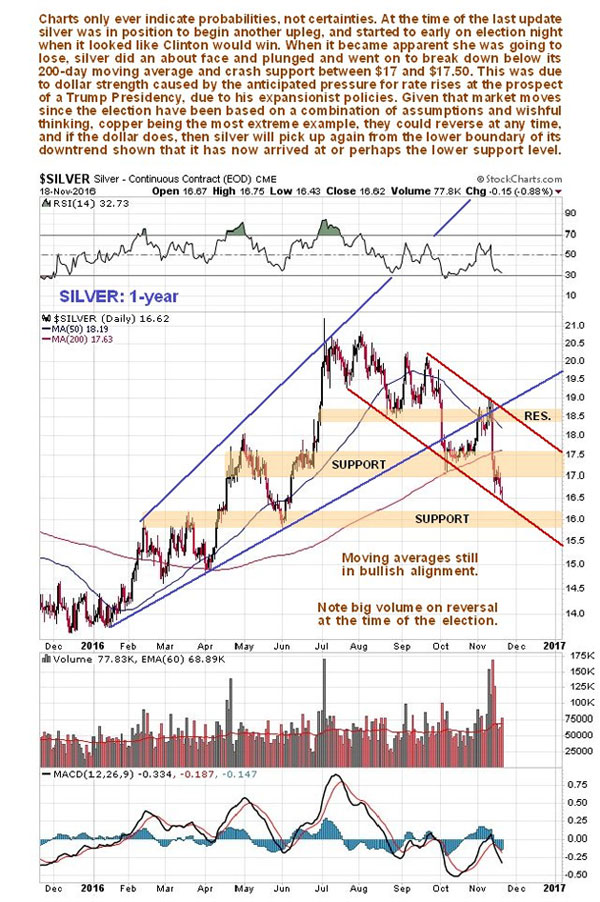
Silver had actually broken down from its uptrend at the time of last update, and well before the U.S. election. But it was thought to look positive going into the election because it was ascending off an important support level and from a rising 200-day moving average. The outcome may have been positive had Trump lost as expected, but he won, which triggered a sharp rally in the dollar and an about face and plunge in both gold and silver.

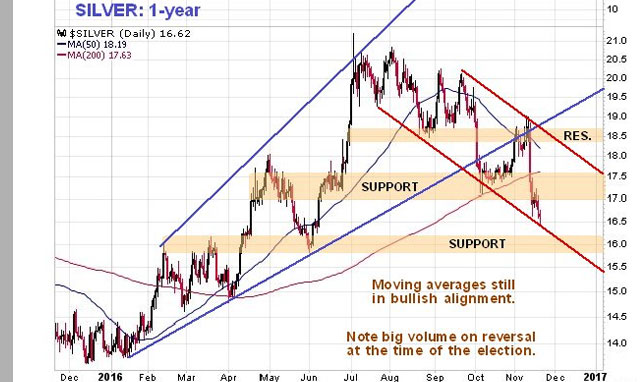
On silver’s 1-year chart, we can see how silver was on the point of battling its way back into its failed uptrend at the time of the election. But Trump won and it caved in, breaking below an important support level and well below its rising 200-day moving average, which had earlier supported the price and set off a doomed rally.

Now silver has arrived at the lower boundary of a newly delineated downtrend, and is closing on the next important support level at a time when the dollar has arrived at an upside target. All this, plus the fact that the price is now below a rising 200-day moving average suggests a high probability that it will turn up soon. This is made even more likely by extremely low sentiment readings toward mining stocks, with the Gold Miners Bullish Percent Index (shown in the companion gold market update), at a very low 7%, which is way below where it was before the big sector rally started back last January.

maundsilver1_11-20

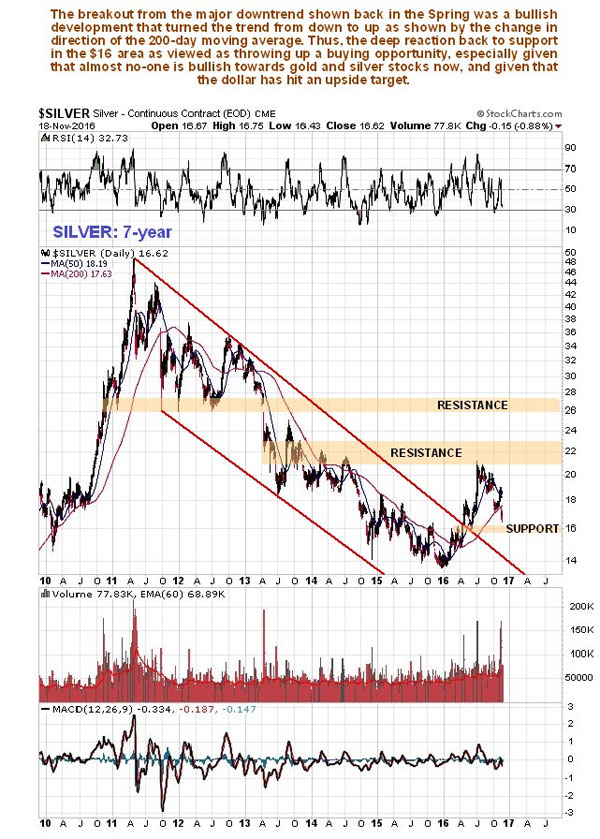
The advance by silver during the first half of the year is regarded as an impulse wave, or a move in the direction of the primary trend, because it broke the price clear out of a downtrend that had been in force from May 2011. As we can see on the 7-year chart below, it is in the process of swinging the direction of the long-term 200-day moving average from down to up, the classic signature of a change in the direction of the major trend, although this does not always work. It turned up in October 2012, at the time of a bull trap. But in this instance, we have a clear breakout from a long-term downtrend. Thus, the deep reaction of the past several months back to an important support level is viewed as throwing up a major sector buying opportunity.

maundsilver2_11-20